Tools and Approaches for Engaging Volunteers in PeakED Activities
CASE STUDY: The Dibeen Forest Reserve Living Lab
An Operational Model of Environmental Education & Youth Engagement
Context & Objectives
As part of the PeakED project, Desert Bloom established a localized Living Lab within the Dibeen Forest Reserve (Jerash Governorate, Jordan) on April 18, 2026. Dibeen represents one of the most ecologically vulnerable pine-oak habitats in the Middle East. Characterized by Aleppo Pines (Pinus halepensis) growing in remarkably low-rainfall conditions (~400mm annually), the reserve provides habitat for 17+ endangered species, including the Persian squirrel.
The Living Lab shifted learning away from traditional classrooms, transforming the mountain reserve into an open-air classroom for over 24 youth workers, eco-entrepreneurs, and civic stakeholders.
THE DIBEEN LIVING LAB METHODOLOGY
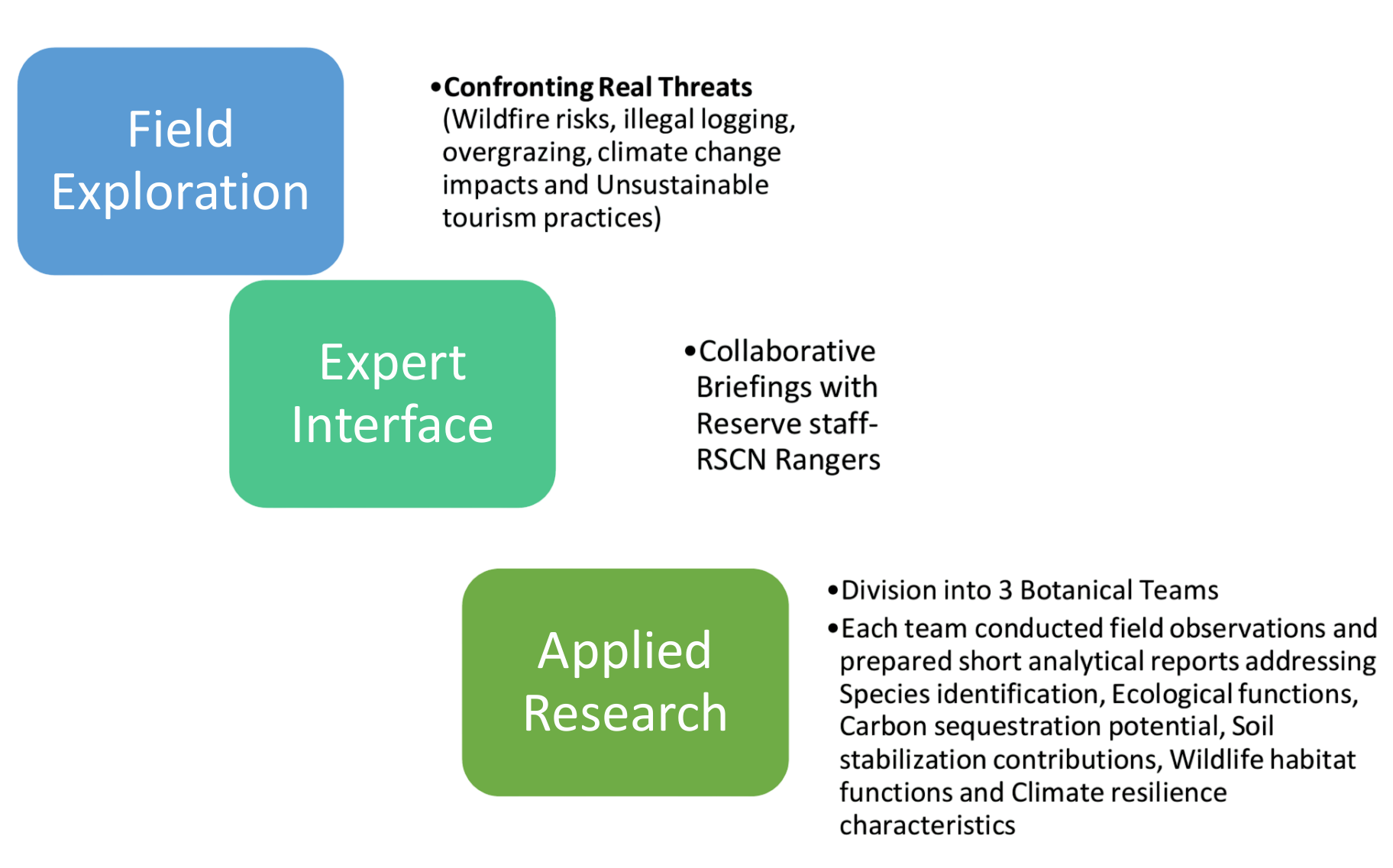
Field Sub-Team Research Mandates & Findings
| Sub-Team & Focus | Target Species | Key Findings |
|---|---|---|
| Team 1: Semi-Arid Canopy Pioneers | Aleppo Pine (Pinus halepensis), Greek Strawberry Tree (Arbutus andrachne), Palestinian Pistachio (Pistacia palaestina). | Documented how deep root networks preserve fragile mountain slopes from erosion while providing a vital early season food supply for local pollinators. |
| Team 2: Keystone Mediterranean Hardwoods | Evergreen Oak (Quercus calliprinos), Deciduous Oak (Quercus ithaburensis), Carob (Ceratonia siliqua). | Mapped how dense oak canopies create critical micro-habitats that lower local ground temperatures, driving nutrient cycling via leaf-litter decomposition. |
| Team 3: Edge Ecosystem & Connectivity Guardians | Deciduous Oak variants (Quercus spp.), Hawthorn (Crataegus azarolus). | Analyzed the role of boundary vegetation in providing ecological buffer zones and migratory corridors for birds along forest edges. |
Quantifiable Impacts & Evaluation Metrics
Post-activity evaluation data gathered from the participants demonstrated high program efficacy:
- 94% reported measured increases in baseline technical knowledge regarding forest eco services.
- 91% certified that immersive field learning was significantly more effective than traditional indoor formats.
- 89% committed to ongoing, long-term environmental volunteer projects.
Participant Testimonies
“Participating in the PeakED Living Lab completely changed my perspective on forests and biodiversity. Seeing the ecosystem firsthand made the environmental challenges feel real and urgent.” — Mohammad Nour, University Student Participant
“The activity created a valuable bridge between youth initiatives and environmental institutions. It showed how collaboration can lead to stronger and more sustainable conservation efforts.” — Rafah Doa, Youth Worker and Environmental Advocate
“As a social enterprise representative, I found the discussions around eco-tourism and sustainable livelihoods extremely inspiring. The Living Lab highlighted how environmental protection can also support local economic development.” — Mohammad Alfar, Social Enterprise Representative